
Healthcare AI has a credibility problem and a deployment problem — and they are not the same thing. The credibility problem is the gap between a conference demo and a winter flu surge in a corridor that was never designed to be a ward. The deployment problem is procurement, governance and the simple fact that a model trained on US billing codes does not understand NHS referral pathways.
Over six weeks I visited three NHS trusts, two private hospitals and a digital-first GP group. The picture that emerged is less “robot doctors” and more a patchwork of narrow tools: symptom checkers that route patients, documentation assistants that claw back typing time, and imaging models that flag studies for human review. None of it replaces a clinician. Some of it genuinely helps.
Triage chatbots: useful router, dangerous oracle
Patient-facing triage bots are the most visible layer. NHS 111 online already uses algorithmic branching; newer LLM-powered interfaces add conversational flexibility. At one trust piloting a chat-first entry point, patients described symptoms in plain language and received a disposition — self-care, pharmacy, GP within 48 hours, or A&E.
The wins were measurable: average call-handling time dropped for straightforward cases, and patients who needed urgent care were flagged faster when the bot correctly recognised red-flag language. The failures were quiet and worrying — a patient with atypical cardiac symptoms whose phrasing did not match training examples was routed to self-care until a nurse reviewed the transcript two hours later. No harm occurred, but the near-miss is the story.

Documentation: where AI pays for itself first
Clinicians hate typing. Ambient documentation — models that listen to consultations and draft notes — is the least glamorous and most adopted category. A consultant physician at a Manchester trust told me she reclaimed forty-five minutes per clinic session, time she now spends on follow-ups rather than clicking through templates.
Quality varies. The best systems distinguish speaker roles, expand abbreviations safely and highlight uncertain transcriptions. The worst produce plausible nonsense — a “patient denies chest pain” line when the patient clearly described angina. Every trust we spoke to mandates clinician sign-off before notes enter the record. That is not bureaucracy; it is the minimum viable safety layer.
“AI in the clinic should be held to the same standard as any other medical device: clear evidence, clear accountability, and a human who remains responsible for the decision.”
— NHS England, guidance on AI-assisted clinical documentation, via gov.uk
GP practices using third-party scribes must also navigate IG — information governance — reviews. Data cannot leave UK servers without explicit agreements. Vendors who treat NHS contracts like generic SaaS deals do not last long in procurement.
Radiology copilots: second eyes, not second opinions
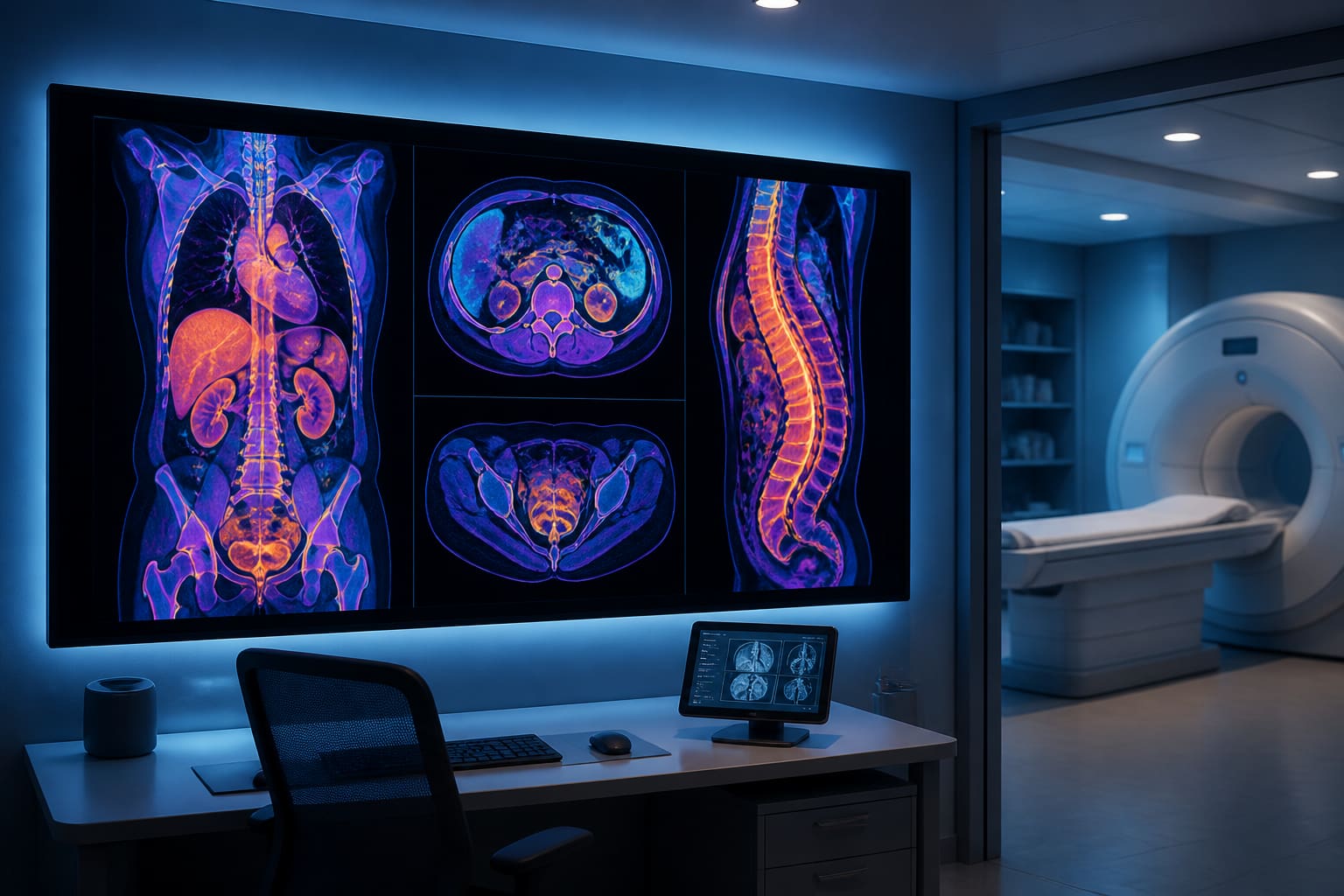
Imaging AI is the most mature clinical category. CE-marked and UKCA-aligned tools flag pulmonary nodules, quantify tumour burden and prioritise worklists so urgent scans rise to the top. At a London teaching hospital’s radiology hub, a copilot model ran alongside reporting radiologists for chest CTs. Sensitivities for large nodules matched published trials; the value was workflow — cutting time-to-report for incidental findings that might otherwise sit in a queue for days.
Radiologists were unanimous on one point: they want heatmaps and confidence scores, not a binary “normal/abnormal” label. A black box that says “refer” without showing why erodes trust. The vendors winning contracts expose saliency maps and integrate with PACS without forcing a separate login.
Evidence, bias and the regulation gap
Peer-reviewed evidence is catching up but still uneven. A 2025 Nature Medicine review noted that many deployed models lack prospective real-world validation — trials run in clean datasets do not predict winter staffing shortages or outdated scanners in district general hospitals. Bias remains structural: underrepresentation of darker skin tones in dermatology training sets still produces worse sensitivity on pigmented lesions.
In the UK, the MHRA’s AI-as-a-medical-device framework is clearer than it was two years ago, but founders confuse “CE marked” with “NHS ready.” Trusts demand DPIAs, clinical safety cases and often a local evaluation period. The EU AI Act’s high-risk classification for certain diagnostic tools adds another compliance layer for vendors selling across borders.
What patients should know
If your GP uses an AI scribe, you should be told — NHS guidance expects transparency. You can ask for a human-only note if you prefer. Symptom checkers are not diagnostic devices; they are routing tools. If something feels wrong, bypass the bot and call 111 or 999 as appropriate.
Consumer health apps that offer “AI diagnosis” from a phone photo occupy a grey market. MHRA has warned several apps marketing beyond their clearance. Treat them as informational, not authoritative.
The next twelve months
Expect more ambient documentation in secondary care, wider imaging AI in breast and stroke pathways, and harder questions about LLM triage liability when something goes wrong. Foundation models will enter trials as research assistants — summarising literature, drafting audit responses — long before anyone trusts them with autonomous decisions.
The NHS will not AI its way out of the waiting list alone. Workforce, estates and social care matter more. But the tools that survive contact with real wards — narrow, auditable, clinician-in-the-loop — are already changing how a Tuesday clinic feels.
Verdict
Pros
- Documentation and imaging tools show measurable time savings
- UK governance frameworks are maturing
- Clinician-in-the-loop designs align with safety culture
Cons
- Triage bots can miss atypical presentations
- Evidence base uneven across specialties
- Procurement and IG slow down useful pilots
Sources
- NHS England, “Artificial intelligence in health and care” — gov.uk
- Nature Medicine, “Validation gaps in clinical AI deployment” — nature.com
- BBC News, “NHS and AI technology coverage” — bbc.com