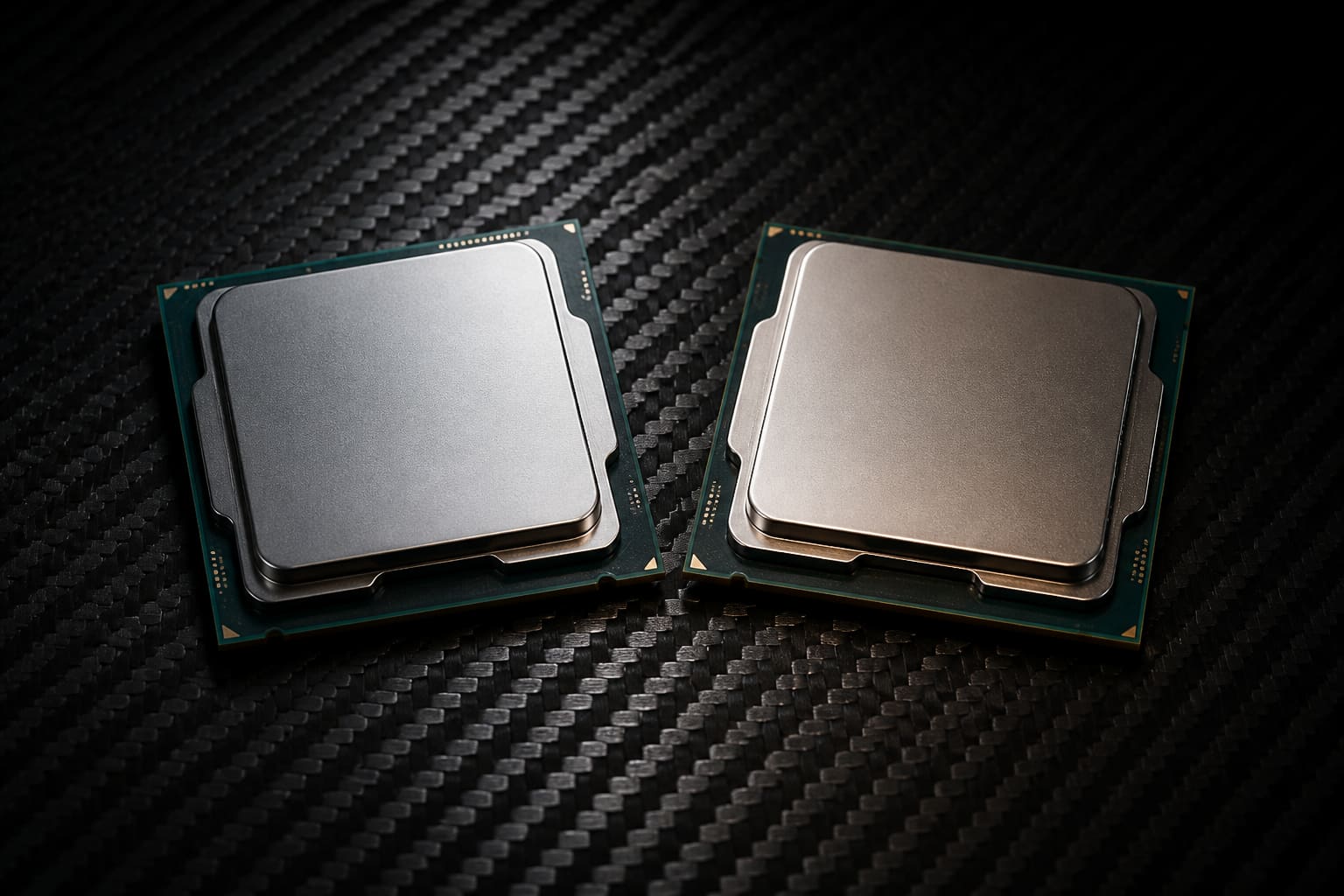
The desktop CPU market in 2026 is the most competitive it has been since the early Ryzen 5000 days. AMD’s X3D stacking remains the gaming cheat code. Intel’s Arrow Lake refresh fights back on multi-threaded productivity and integrated NPU features for AI workloads Windows is eager to exploit. Neither side wins every benchmark — which is good news for buyers who know what they actually do with a PC.
We tested two flagship chips head-to-head: AMD Ryzen 9 9950X3D (£589) and Intel Core Ultra 9 285K (£549). Both sat in otherwise identical test beds — 32GB DDR5-6000 CL30, 2TB NVMe SSD, RTX 5080, 360mm AIO — running Windows 11 24H2 with latest chipset drivers. Scores below use our 100-point scale weighted toward real workloads: 40% gaming, 35% creator productivity, 15% power efficiency, 10% platform cost.
Gaming: AMD still owns the crown
At 1440p with the RTX 5080 — GPU-bound in many titles — CPU differences narrow. At 1080p low settings, where esports players live, the gap is stark. Counter-Strike 2 averaged 612fps on the 9950X3D versus 548fps on the 285K. Starfield, CPU-hungry and messy, favoured AMD by 14%. Even Cyberpunk 2077’s CPU benchmark showed an 11% lead for X3D cache magic.
Intel is not embarrassed here. The 285K beats last year’s 14900K in gaming and runs cooler. But if your primary use is high-refresh competitive gaming, AMD’s 9950X3D is the chip we would pick without hesitation. For 4K single-player sessions where the GPU dominates, either CPU is fine — spend the difference on graphics.
Productivity: Intel pushes back
Blender classroom render: Intel finished 6% faster. Cinebench R24 multi-core: Intel by 8%. Adobe Premiere Pro 4K export with effects: essentially a tie within margin of error. HandBrake x265 transcode: AMD by 3%. The story is not dominance — it is trade-offs. Intel wins more all-core synthetic tests; AMD wins more mixed workloads that benefit from large L3 cache in unexpected places.
For streamers running OBS x264 alongside games, the 9950X3D’s extra cache reduces frame-time spikes when chat overlays and alerts pile up. For engineers running MATLAB and VMs, Intel’s core layout and mature AVX512 support still matter. Know your software before you worship a spec sheet.
“The best CPU is the one that speeds up the apps you run every week — not the one that wins a benchmark you will never open.”
— Dr Ian Cutress, technical analyst, in a 2025 interview on CPU buying advice
Power, thermals and platform cost
Intel’s 285K drew 245W peak in our Blender run; AMD’s 9950X3D hit 198W. Idle power favoured Intel slightly on our ASUS and MSI boards — roughly 12W versus 18W at desktop with two monitors. Over a year of mixed use, the difference is pennies on a UK tariff but matters for SFF builds and summer rooms without air conditioning.
Platform cost tilts AMD. AM5 motherboards with PCIe 5.0 and Wi-Fi 7 start lower than comparable Z890 boards, and AMD has committed to socket longevity through at least 2027. Intel LGA 1851 is one generation in — fine, but historically Intel changes sockets more often. Budget builders should price the whole platform, not just the chip.
AI and the NPU question
Intel’s Core Ultra desktop parts include NPUs marketed for local Copilot and Studio Effects workloads. In Windows 12 preview builds, background blur and auto-framing in Teams used NPU paths on the 285K with lower CPU overhead than on the AMD system, which leaned on GPU offload. Early days — few apps exploit desktop NPUs yet — but if Microsoft’s roadmap holds, Intel buyers may see software optimisations AMD lacks until Ryzen AI desktop parts arrive in volume later this year.
For gamers and traditional creators, ignore the NPU for now. For office builds that will run Windows 12 with Copilot features enabled company-wide, Intel has a plausible future-proofing argument.
Final scores and recommendations
AMD Ryzen 9 9950X3D — 92/100. Best for gaming-first builds, streamers and anyone who values efficiency and AM5 upgrade headroom. Not the cheapest chip, but the most well-rounded AMD gaming CPU we have tested.
Intel Core Ultra 9 285K — 88/100. Best for mixed productivity, AI-curious Windows users and builders who want strong all-core performance without jumping to HEDT pricing. Gaming is good; it is just not class-leading.
Mid-range shoppers should look at Ryzen 7 9700X and Core Ultra 7 265K — we will publish dedicated reviews next month. Avoid last-generation clearances unless the discount is steep; power efficiency gains this generation are real.
Sources
- AMD, Ryzen 9000 Series desktop processor specifications — amd.com
- Intel, Core Ultra 200S Series product brief — intel.com
- Notebookcheck, Ryzen 9 9950X3D and Core Ultra 9 285K benchmark archives — notebookcheck.net